AutoRemesher
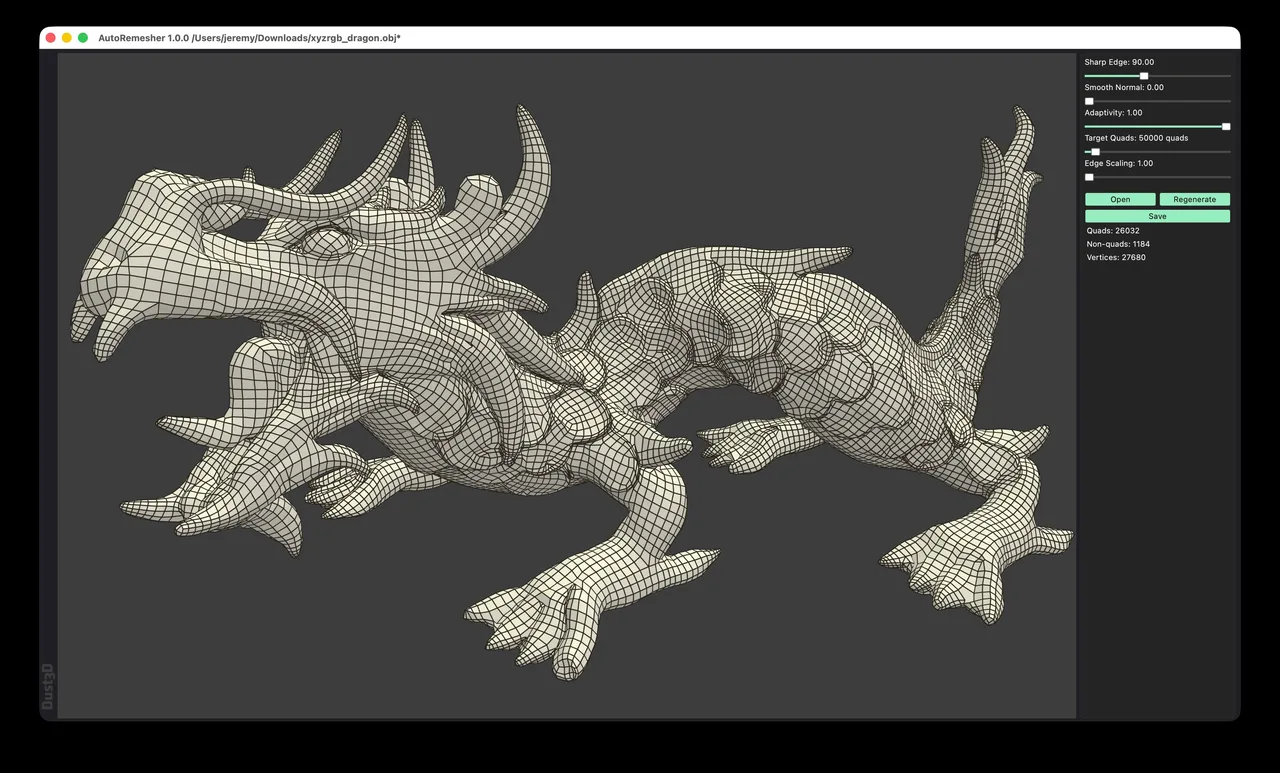
Free, MIT licensed automatic quad remesher with a desktop app and a headless CLI, revived in 2026 after six years of dormancy.
Automatic quad retopology plugin for 3ds Max, Maya, Blender, Modo, Houdini and Fusion 360, written by the author of ZBrush's ZRemesher.

Quad Remesher is an automatic quad remeshing plugin sold by Exoside, the one-person software company of Maxime Rouca. Rouca also wrote ZRemesher, the auto-retopology engine built into ZBrush, and industry press covering the 2019 launch described Quad Remesher as the same algorithm from the same coder, freed from a single host application. That lineage is the whole point of the product: it puts ZRemesher-class edge flow inside the application where the asset will actually be rigged, unwrapped and rendered, instead of forcing a round trip through ZBrush. Architecturally it is a thin bridge rather than a native plugin. The host add-on exports the selected geometry, calls a separate engine binary (xremesh) with the parameters from the panel, and reads the new quad mesh back into the viewport, which is why the same topology comes out of Blender, Maya and Houdini alike. It is a one-job tool with a short parameter list: a target quad count, an adaptive-size slider, symmetry axes, and several ways to pin edge loops to hard edges, material borders or custom normals.
The solver is the work of Maxime Rouca, who wrote ZBrush's ZRemesher before founding Exoside. It is a cross-field method that aligns quads with surface curvature, which is why its loops circle eyes, mouths and joints instead of laying down the uniform grid that free remeshers tend to produce.
3ds Max 2016+, Maya 2012+ (not Maya LT), Blender 2.8+, Modo 10+, Houdini 17+, Fusion 360 and Nomad Sculpt. The plugin only supplies the panel; the remeshing runs in a shared binary, so topology quality does not vary by host.
There is no guide-curve brush like ZBrush's. Local density is steered by painting vertex colours in Blender, or by a primitive attribute in Houdini, and edge loops are pinned by hard-edge angle, material borders, custom split normals or creases.
Mirroring across X, Y, Z or any combination is handled inside the algorithm rather than by bisecting and mirroring the mesh afterwards, which is what riggers need when left and right weight painting has to match.
New topology means new vertex indices, so existing UV maps and texture assignments are gone after a remesh. The tool sits before unwrapping and baking in a pipeline, never after: retopologise a duplicate, unwrap the result, then bake the high-poly detail down onto it.
The Fusion 360 build handles NURBS and BREP data and is priced in its own tier: USD 199.90 perpetual against USD 109.90 for a standard host. An all-software licence covering both polygonal and CAD hosts is USD 239.90.
Recurring themes across third-party user reviews (G2, Capterra, TrustRadius).


Quad Remesher is not free. It is paid software with no free tier, though a time limited trial may be offered.
| Plan | Price | What you get |
|---|---|---|
| Perpetual Pro, one host | USD 109.90 | Commercial use. Minor upgrades are free; a major version bump is not. Prices exclude VAT. |
| Perpetual Indie, one host | USD 59.90 | Same software, licensed strictly for non-commercial work. |
| Subscription, one host | USD 15.99 / 3 months | Commercial use, and the only tier that carries you across a major version change at no extra cost. |
| Perpetual Pro, all hosts | USD 139.90 | Every supported application except Fusion 360. Roughly the price of one and a quarter single-host licences. |
| Perpetual Pro, CAD (Fusion 360) | USD 199.90 | CAD geometry sits in its own tier. All hosts including CAD is USD 239.90; the Indie equivalents are USD 129.90 and USD 159.90. |
If your sculpting happens in Blender, Nomad Sculpt or Modo, this is the closest thing to ZRemesher available, and it runs where the model already is.
Assigning a separate material to each panel turns material borders into hard constraints, which is the practical way to force clean panel gaps and edge loops that survive subdivision.
Photogrammetry output and generative 3D both arrive as dense triangle soup. Voxel-remesh it into a closed shell first, then this turns it into something riggable.
The all-software licence covers every supported host on the same machine, so a base mesh made in Blender and finished in Maya needs one purchase, not two.
The solver works globally from general rules, so you cannot guarantee a specific five-pole at the corner of a mouth. Facial rigs that depend on precise loop layout still call for manual retopology.
UVs and materials are destroyed by the remesh. If the texture work is already done and cannot be rebaked, this is the wrong stage of the pipeline to be at.
Maxon built the same algorithm into Cinema 4D R26 in April 2022, and Exoside stopped selling the C4D plugin to anyone who registered after 20 April 2022. The native Remesh option covers this now.
There is no floating licence server. Licences are tied to a person and activated per machine, so a big deployment means contacting Exoside for custom terms.
Same author and the same algorithmic approach, different packaging. Maxime Rouca wrote ZRemesher for ZBrush, then built Exoside to sell the solver as plugins for other applications. ZBrush keeps advantages its own environment allows, notably PolyGroups and a guide brush for drawing edge flow; Quad Remesher's advantage is that it runs inside the application where you will rig and render.
Two. Exoside's documentation states you can install, activate and use it on two computers as long as both are owned and used by the same person. The all-software tier additionally lets you run it in several host applications, on that same machine.
Minor ones only. The documentation puts it plainly: minor upgrades such as 1.0 to 1.1 to 1.2 are free for perpetual licences, but a major upgrade such as 1.0 to 2.0 is not. Subscriptions include every upgrade while they are active, which is the real trade-off between the two models.
No. Remeshing builds entirely new topology, so the vertex indices the UV layout was attached to no longer exist. The standard route is to duplicate the textured high-poly model, remesh the copy, unwrap the new mesh, then bake the original's normal and colour detail onto it.
Only if you were already an Exoside user before 20 April 2022. Maxon integrated the same algorithm natively into Cinema 4D R26 that month, and Exoside stopped selling the plugin to new C4D users from that date. Existing users, including anyone who had merely run the trial, keep access.
Yes, a one-month trial that needs an internet connection. It is fully functional, but its output is licensed for non-commercial use only, so anything you remesh during the trial cannot ship in paid work.
Yes, but as a separate purchase through the App Store that sits entirely outside Exoside's licensing. A desktop licence, including the all-software tier, does not cover the iPad plugin.
Free, MIT licensed automatic quad remesher with a desktop app and a headless CLI, revived in 2026 after six years of dormancy.
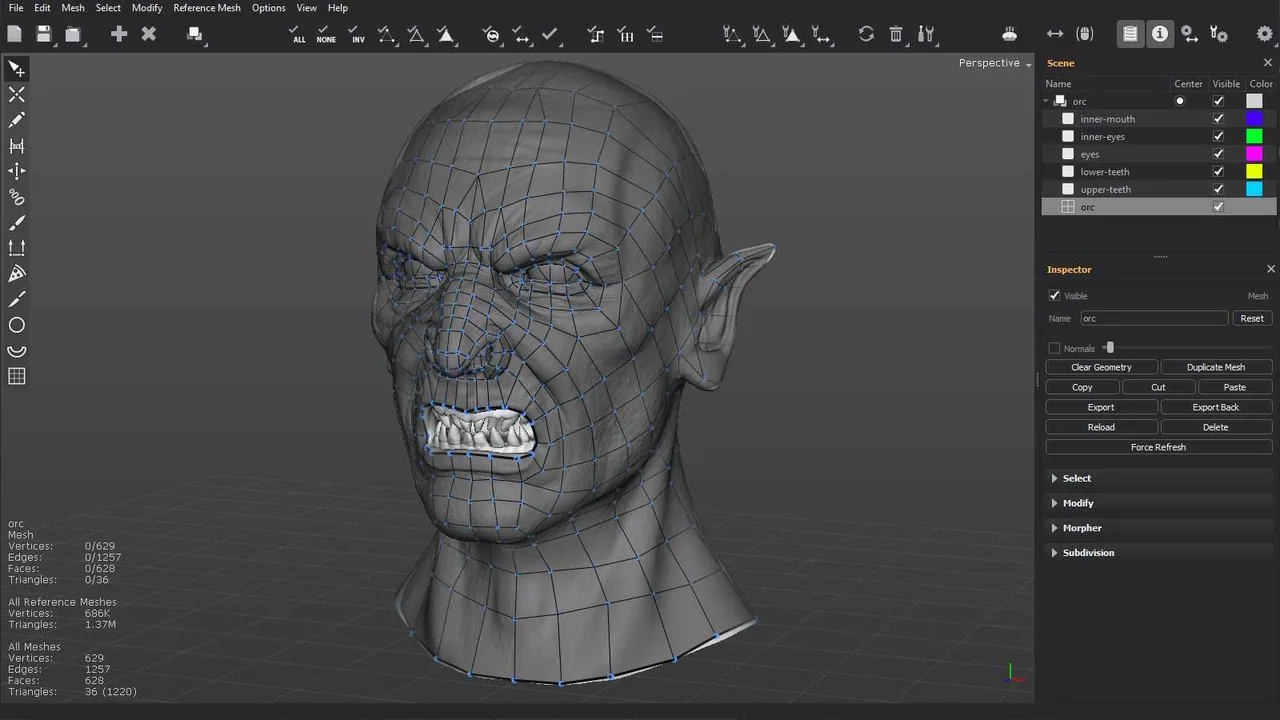
Standalone manual retopology and map baking application built to hold million-polygon reference meshes that make general 3D software crawl.