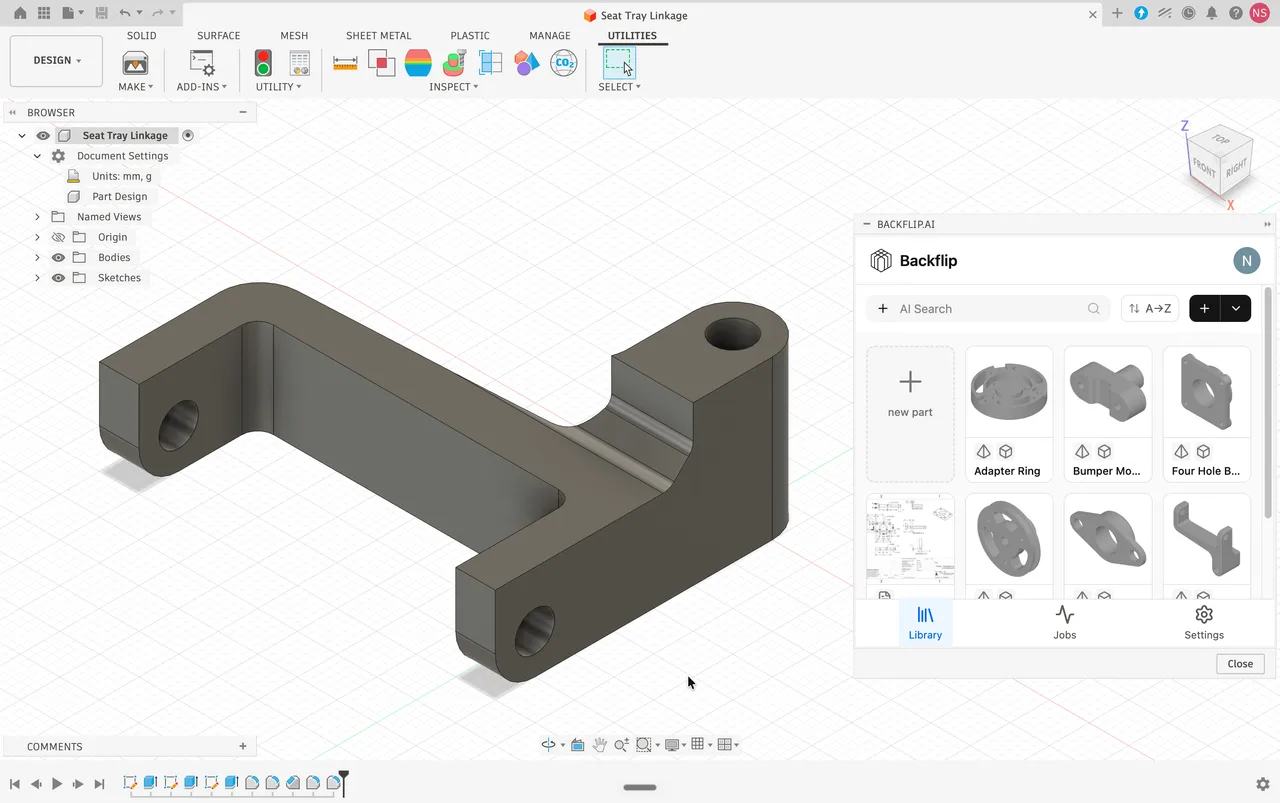
Autodesk Fusion
Cloud-connected CAD, CAM, CAE and PCB in one subscription, strongest on integrated manufacturing and weakest on air-gapped or very large assemblies.
CAD software models exact, manufacturable geometry using parametric features, constraints and NURBS surfaces rather than free form polygons. It is the toolset for product design, mechanical engineering and architecture, and it overlaps with the artistic 3D world mainly through format conversion and visualisation.
Tools in this category: 6
Cloud-connected CAD, CAM, CAE and PCB in one subscription, strongest on integrated manufacturing and weakest on air-gapped or very large assemblies.
Turns 3D scans and STL meshes into editable parametric CAD with a feature tree, as a Fusion add-in or a web app.
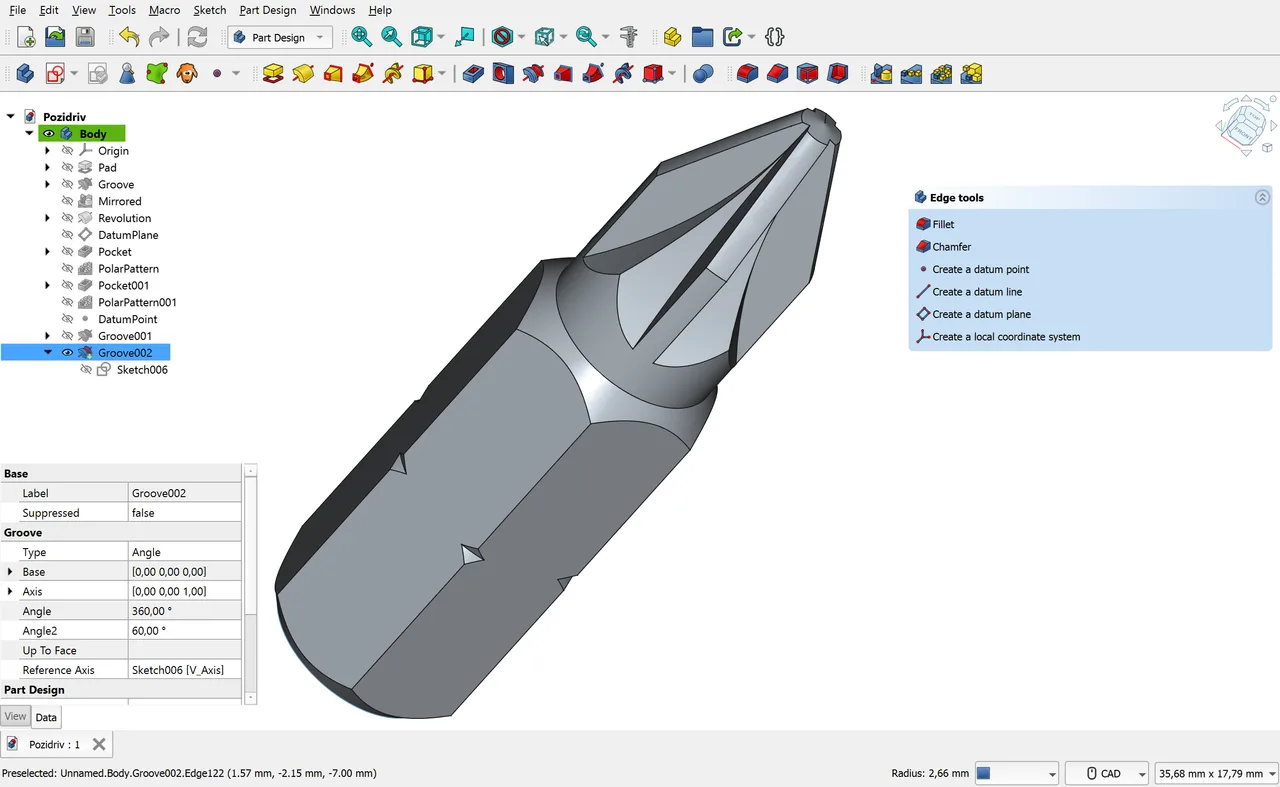
Open source parametric CAD built on the OpenCASCADE B-Rep kernel, with a full Python API and workbenches for mechanical design, BIM, FEM and CAM.
Browser-only parametric CAD on the Parasolid kernel, with built-in version control and branching, and a free tier where every document is public.
The Windows-only mechanical CAD standard, unmatched on sheet metal and drawings, sold through resellers with capabilities gated hard across three tiers.
Autodesk's free browser modeller for beginners and classrooms, built from primitive solids, with a one-way bridge into Fusion and no STEP support at all.
No tools match these filters.
CAD describes shapes as exact mathematical surfaces with dimensions and constraints, so a hole is always exactly its specified diameter. Polygon modeling approximates shapes with faces, which is ideal for art but not for manufacturing tolerances.
Parametric models are built from a history of features driven by dimensions. Change one parameter, such as a length or hole spacing, and the whole model rebuilds. This makes revisions fast and keeps design intent explicit.
Yes, after conversion. CAD geometry must be tessellated into polygons, usually decimated, and given UVs and materials. Several tools in our format conversion category specialise in exactly this workflow.