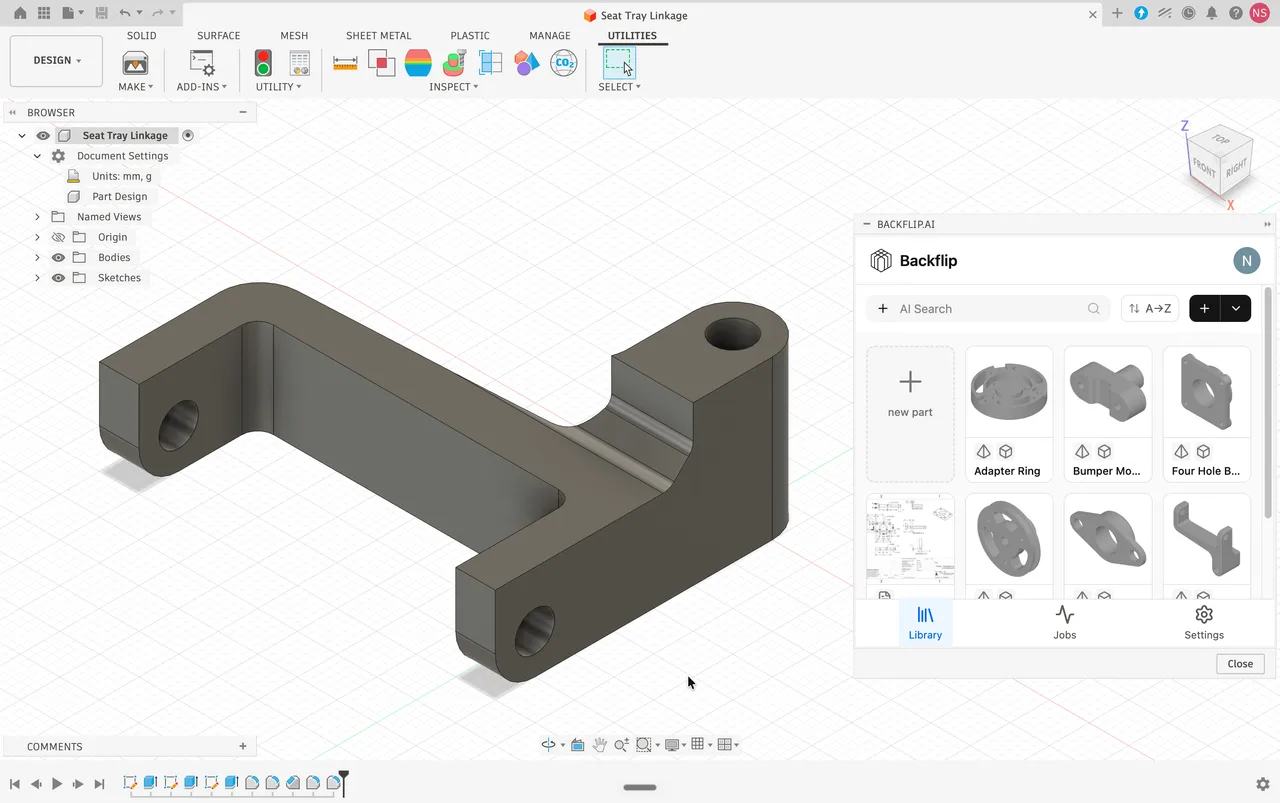
Backflip AI
Turns 3D scans and STL meshes into editable parametric CAD with a feature tree, as a Fusion add-in or a web app.
Open source parametric CAD built on the OpenCASCADE B-Rep kernel, with a full Python API and workbenches for mechanical design, BIM, FEM and CAM.
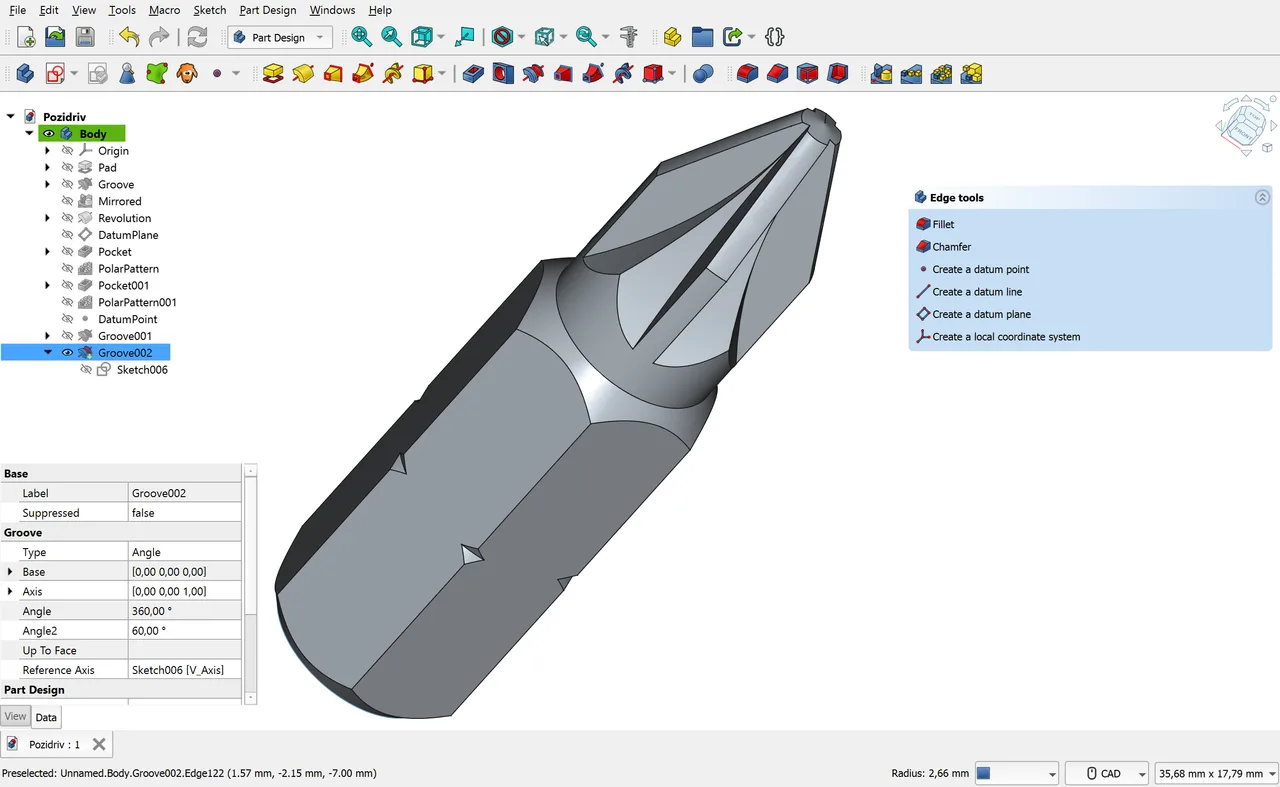
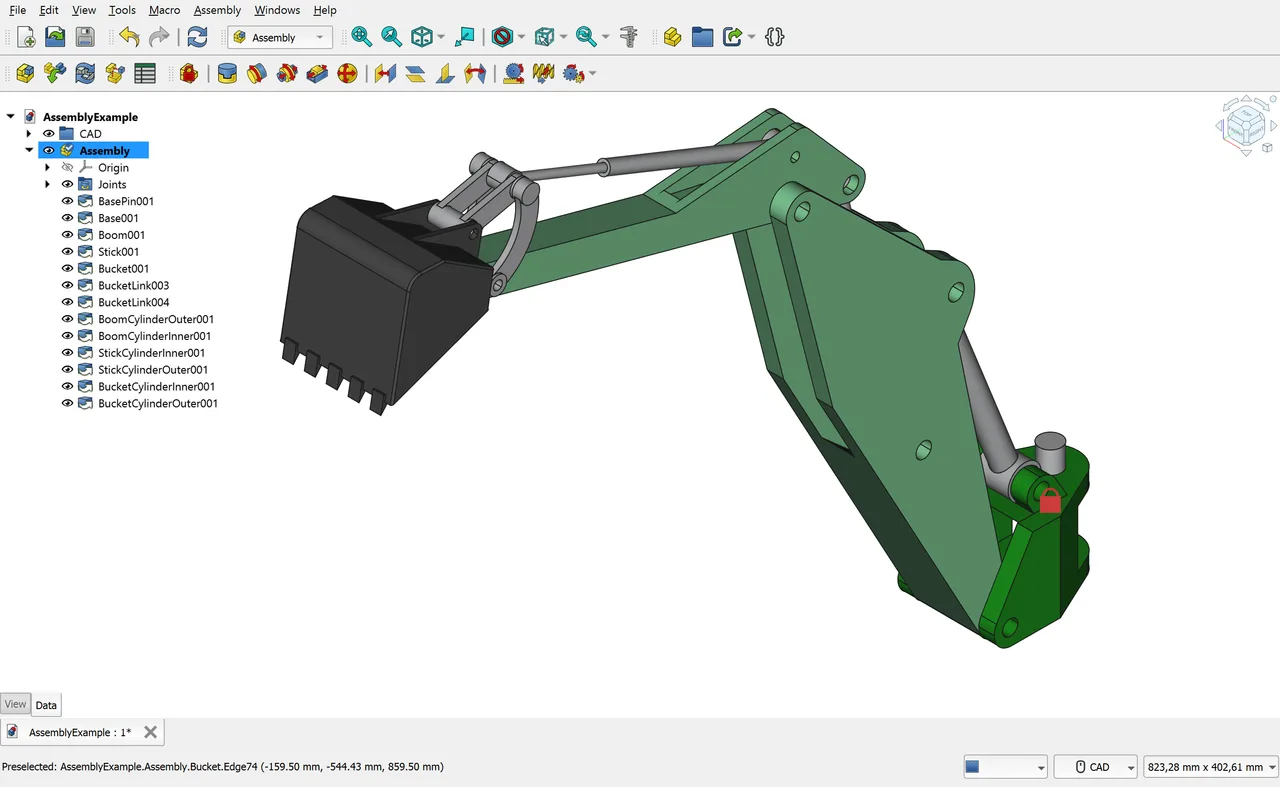
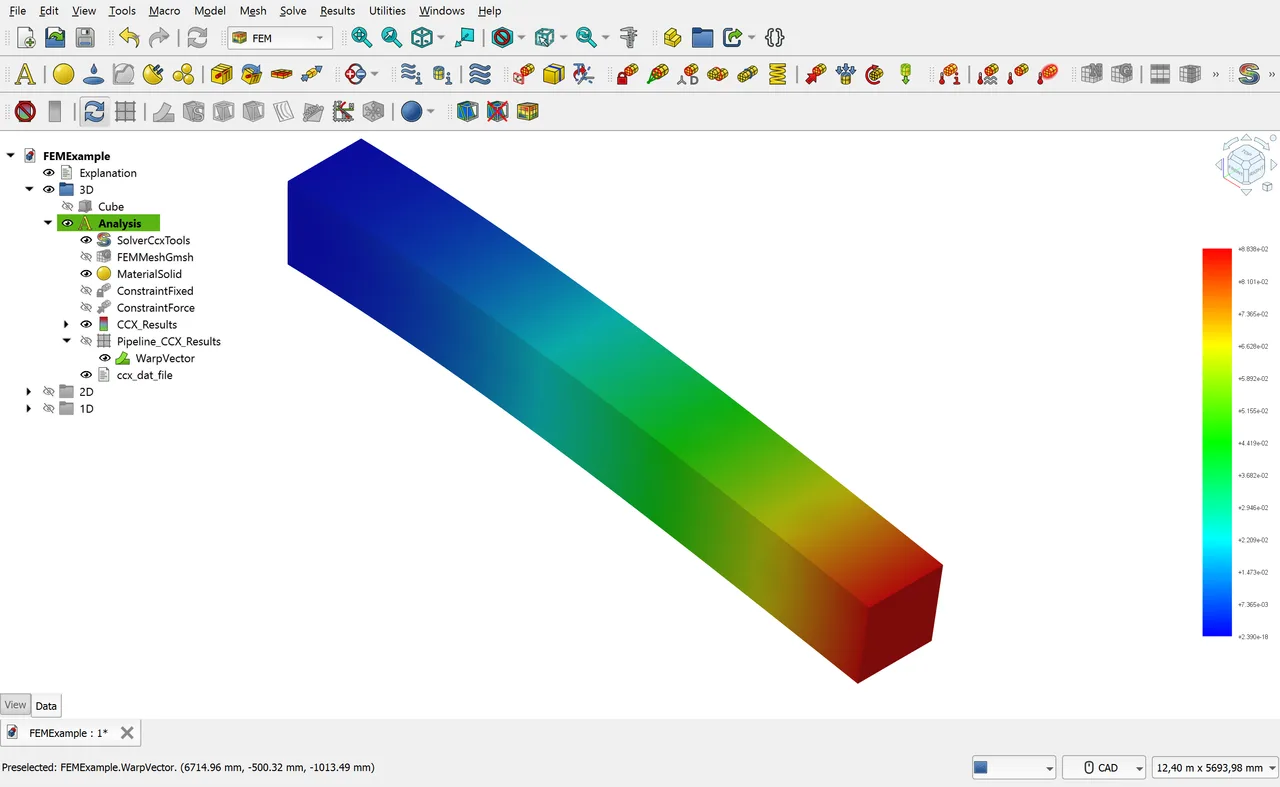
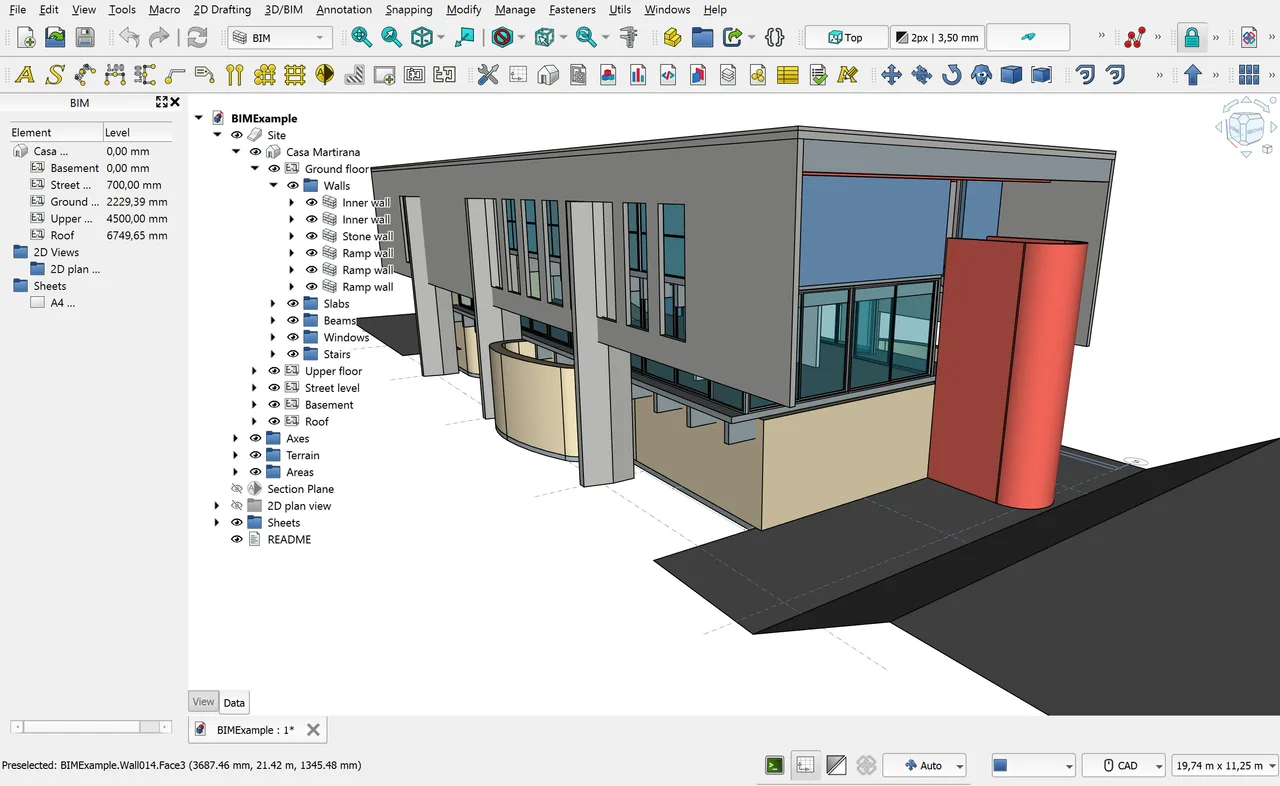
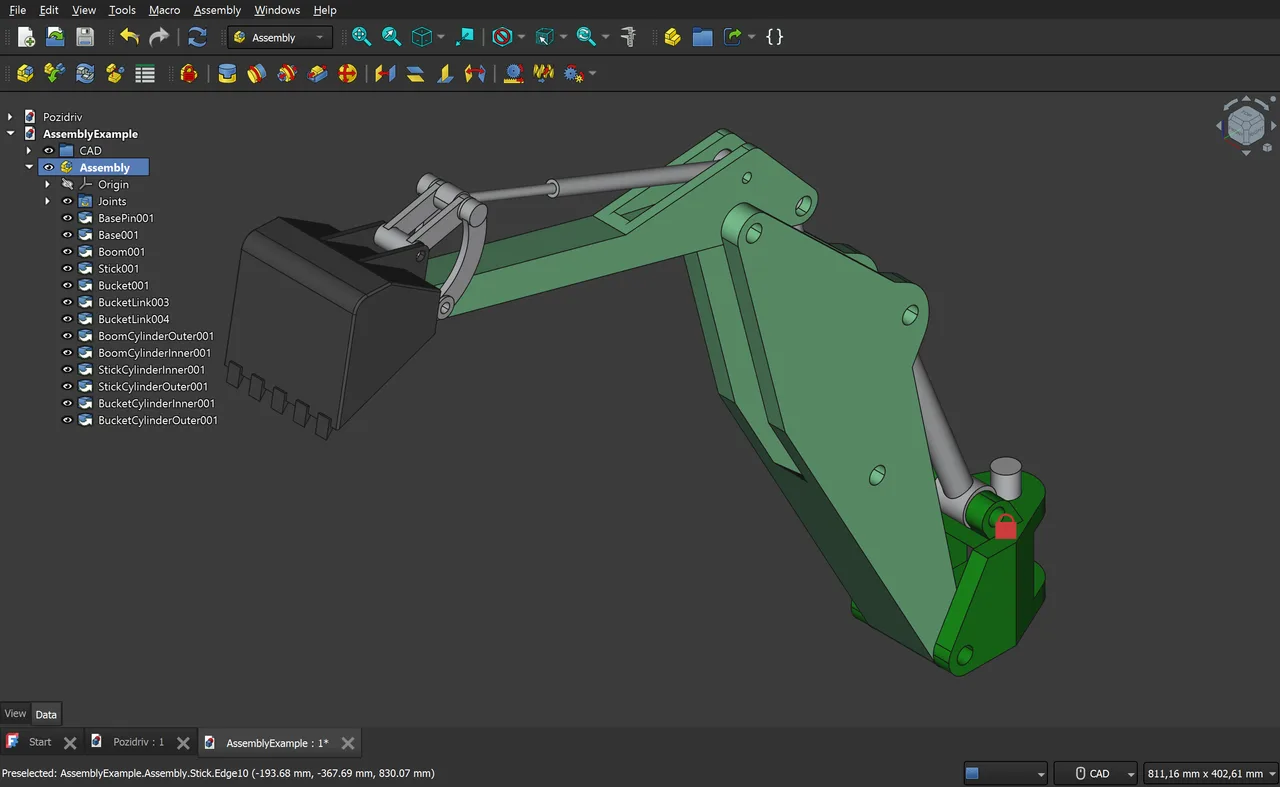
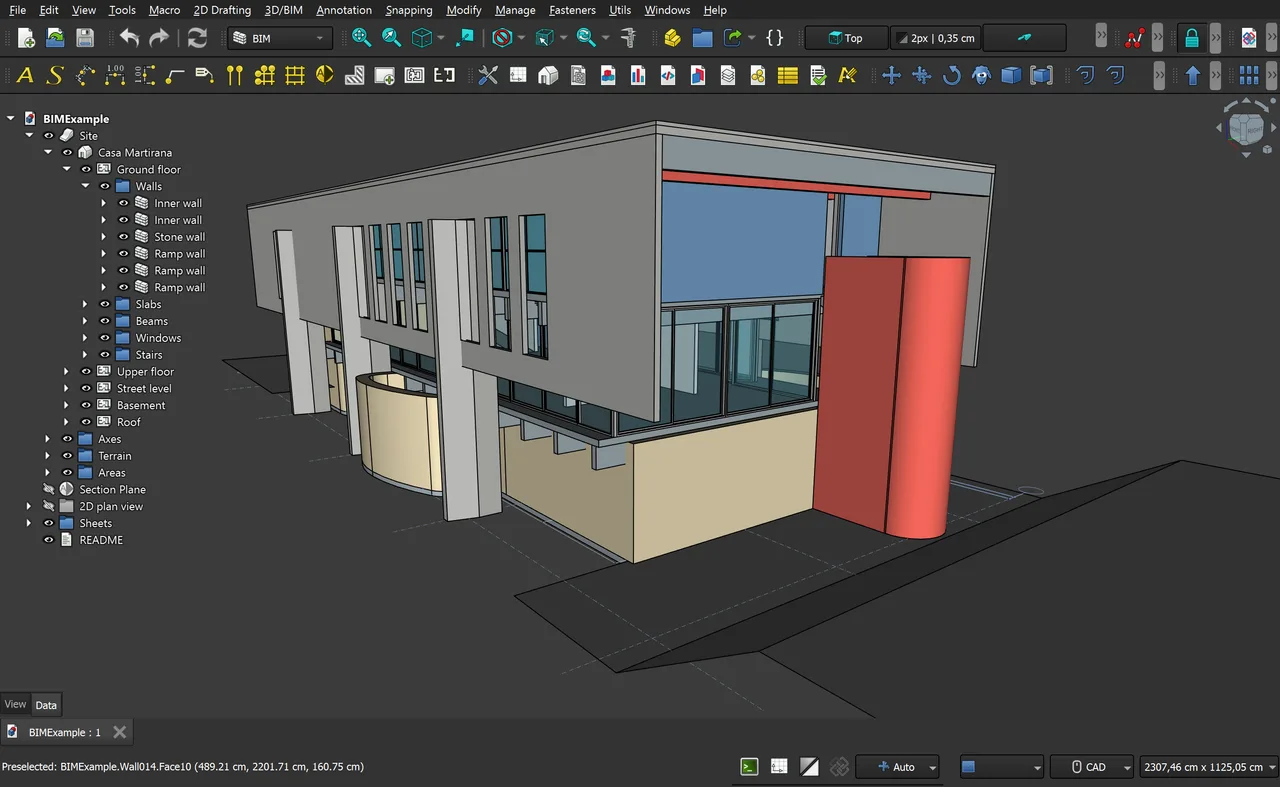
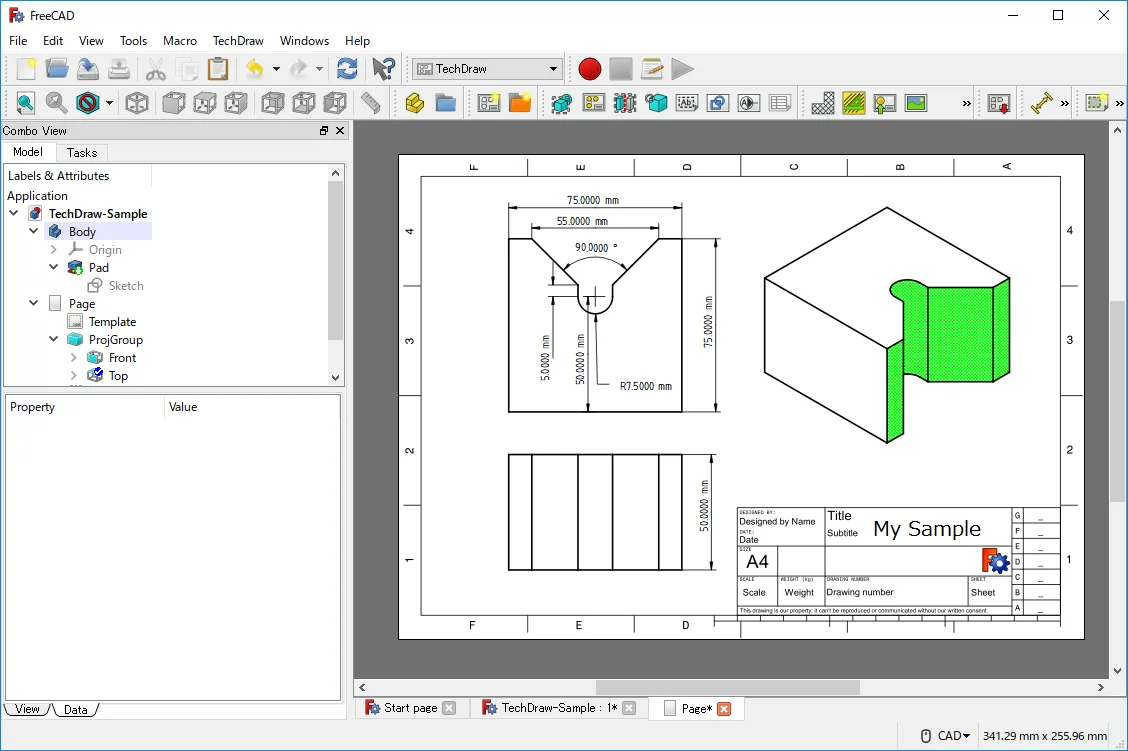
FreeCAD was started in October 2002 by Jurgen Riegel, Werner Mayer and Yorik van Havre, and is maintained by the non-profit FreeCAD Project Association in Brussels. It is built on the OpenCASCADE Technology kernel, so it works in boundary representation and NURBS rather than polygons: a hole is a real cylinder with a computable axis, not an approximation made of triangles. Functionality is split into workbenches for Part Design, Sketcher, Assembly, BIM, FEM and CAM, and nearly every action in the interface maps to a Python command, which makes the whole application scriptable and runnable without a GUI. Two releases define its current state. Version 1.0, on 18 November 2024, added a native Assembly workbench and the first mitigations for the topological naming problem. Version 1.1, on 24 March 2026, added core datum objects, a rebuilt CAM tool library, interactive on-model draggers for fillets and chamfers, and projection and intersection of external geometry in Sketcher. The current release is 1.1.3, from 25 July 2026, which fixes a repeated update warning and nothing more; the security backports people associate with it actually shipped two days earlier in 1.1.2.
OpenCASCADE computes volumes, areas and intersections against mathematical surface definitions, so a cylinder stays a cylinder with a centre you can reference and a wall you can tap. This is the whole difference between FreeCAD and a polygon modeller, and it is why its output is usable for machining rather than only for printing.
Nearly every GUI action maps to a Python command, so work can be recorded as a macro, rewritten as a parametric script, or run headless from the command line. Teams use this to ingest CAD files, reparameterise them programmatically and push them to CAM or to solvers such as OpenFOAM. No commercial CAD tool exposes itself this openly.
Support goes beyond reading geometry to the modern aerospace and automotive standard, carrying product manufacturing information and assembly hierarchy. For a free tool this is unusual, and it is the main reason FreeCAD works as a translation bridge in environments that cannot send files to a cloud service.
Before November 2024 assemblies meant third-party add-ons such as A2plus or Assembly4, with incompatible constraint logic. The built-in workbench uses one solver, produces bills of materials, and gained joint motion simulation in 1.1. On assemblies of thousands of parts, users still report performance well behind commercial systems.
Rather than a proprietary physics engine, the FEM workbench drives CalculiX, Gmsh, Elmer and Netgen from inside the interface. Change a dimension on the original sketch and the meshing and analysis chain updates with it. The cost is that it assumes you already understand the physics, since there is no wizard to fall back on.
Part ShapeFromMesh converts an imported STL into topological shapes, Convert to solid closes it, and Refine Shape runs the OpenCASCADE removeSplitter algorithm to merge coplanar facets into continuous faces. The official wiki presents this as routine. Developer discussions and the issue tracker describe removeSplitter as computationally heavy and prone to geometric exceptions on dense meshes, so budget for it failing on scan data.
Recurring themes across third-party user reviews (G2, Capterra, TrustRadius).
FreeCAD is free and open source. There is no paid edition to upgrade to, and no feature is held back behind a licence.
| Plan | Price | What you get |
|---|---|---|
| FreeCAD | Free forever | LGPLv2+ with no tiers, no watermarks, no commercial restrictions and no API limits. Funded by donations and grants administered by the FreeCAD Project Association. The one attempt to sell a commercial layer on top, the venture-backed Ondsel, shut down in November 2024 and donated its remaining 40,000 EUR back to the association. |
Parametric modelling, drawings, FEM and CAM with no seat cost at all, which is what makes it viable for small manufacturers and hardware startups that cannot carry thousands per seat per year.
The API is the most open in mainstream CAD. Generating families of parts from parameters, or batch converting a directory of files, is ordinary scripting here rather than a paid add-on.
No licence tracking means a design can be published with the source file and rebuilt by anyone, which matters when a project's whole point is that others can modify it.
Runs fully offline with no licence server and no cloud round trip, which is often the deciding factor for defence work and R and D labs regardless of what the software costs.
There is no integrated product lifecycle management, vendor management or real-time multi-user editing. Coordination is expected to happen in tools outside FreeCAD.
Advanced organic surface modelling of the kind automotive exteriors require is not what this kernel and toolset are built for.
The friction reported most often comes from users arriving from Dassault or Autodesk products and finding different paradigms for planes, origins and bodies. It is not the same software with different icons.
Yes, without qualification. It is LGPLv2+ with no paid tier, no watermark, no commercial restriction and no API limit. The only attempt to build a business on top of it, a venture-backed startup called Ondsel founded by core contributors, closed in November 2024 after finding that a paid wrapper had no market among users who chose the software precisely to avoid subscriptions. Ondsel donated its remaining 40,000 EUR to the FreeCAD Project Association, which now issues grants to fold those interface improvements into the free version.
It is mitigated, not cured, and the distinction matters in practice. Version 1.0 added an algorithm that tracks how faces and edges change through the modelling history, but the official documentation still warns that edge numbers are not completely stable, and users continued reporting broken attachments through 2026. The mitigation is best understood as a safety net that reports a broken reference clearly instead of silently producing wrong geometry. The standard defence is unchanged: attach sketches to origin planes and datum planes rather than to generated faces.
It can produce a solid, and it is the only free tool that completes the job, but the result is only editable if you run the final refinement step. Part ShapeFromMesh gives every triangle its own flat face, Convert to solid closes the shell, and Refine Shape merges coplanar facets back into continuous faces. That last command is what separates a usable model from a faceted one. It also fails most often on dense scan data, where the algorithm behind it is prone to geometric exceptions.
The split is philosophical before it is technical. Fusion is cloud-anchored and subscription-based, so access to your own files depends on an account in good standing; FreeCAD is local and permanent. Fusion is ahead on interface polish and on automated CAM toolpath generation, though the CAM library rebuilt in 1.1 narrows that. FreeCAD is ahead on scriptability and on running with no network at all. For mesh to solid work specifically, Fusion's better algorithms sit behind a paid subscription, which changes the free-versus-free comparison considerably.
No licence cost exists, so the real budget line is time. Expect a longer ramp-up than any commercial alternative, occasional instability on complex models, and some internal Python work to reproduce automation that commercial suites ship with. Reviews reflect the pattern: SourceForge shows an overall 4.5 but rates ease of use at 3 out of 5, and its 124 ratings split sharply into 105 five-star and 12 one-star with almost nothing in between.
No, and this is widely misreported. FreeCAD's own announcement for 1.1.3, dated 25 July 2026, says it fixes repeated version update warnings when saving files and states plainly that no security risks or crashes are involved. The security work shipped two days earlier in 1.1.2, where roughly 12 percent of the backported patches were security fixes and 32 percent addressed BIM, Arch and the core.
STEP is the one that matters, and support extends to AP242, the standard used in aerospace and automotive that carries product manufacturing information and assembly structure alongside geometry. IGES and BREP are also supported for older workflows, IFC for BIM, and DXF for 2D. DWG works through an external converter that has to be installed separately rather than being built in.
Turns 3D scans and STL meshes into editable parametric CAD with a feature tree, as a Fusion add-in or a web app.
Cloud-connected CAD, CAM, CAE and PCB in one subscription, strongest on integrated manufacturing and weakest on air-gapped or very large assemblies.
Browser-only parametric CAD on the Parasolid kernel, with built-in version control and branching, and a free tier where every document is public.
The Windows-only mechanical CAD standard, unmatched on sheet metal and drawings, sold through resellers with capabilities gated hard across three tiers.
Autodesk's free browser modeller for beginners and classrooms, built from primitive solids, with a one-way bridge into Fusion and no STEP support at all.