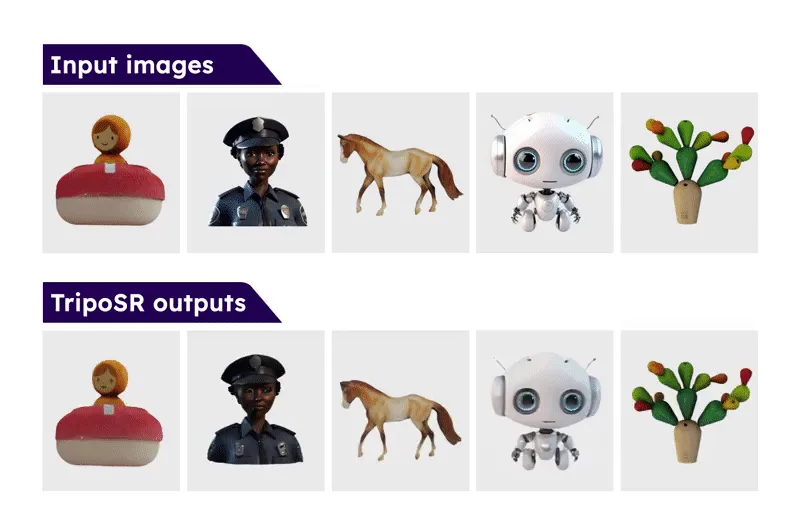
TripoSR
Open MIT-licensed single-image to 3D model from VAST AI and Stability AI. Runs locally, exports OBJ or GLB, and bakes colour into vertices rather than textures.
Stability AI's two-stage image to 3D model with built-in triangle and quad remeshing. Free under a revenue threshold, and dormant since May 2025.
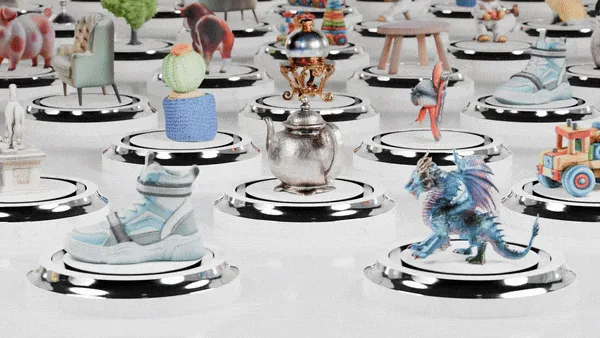
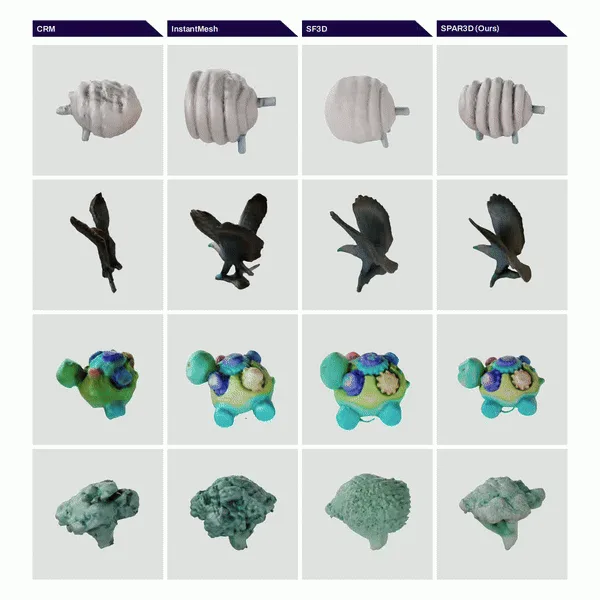
SPAR3D reconstructs a 3D object from a single image in two stages: it first diffuses a point cloud, then regresses a mesh from it. The point cloud stage is the interesting part, because it can be edited between the two stages, which gives a degree of control over the result that single-shot models do not offer. Its other distinguishing feature is remeshing built into the export path, including a quad option with real edge flow and a target face count. Two things to know before investing in it: the licence is free only below a revenue threshold, and the repository has had no commits since May 2025.
The two-stage design exposes an intermediate point cloud that can be edited before the mesh is regressed from it. That is a genuine control surface, and single-pass models have nothing equivalent.
The --remesh_option flag runs either a triangle remesh for even distribution or a quad remesh using Instant Field-Aligned Meshes for proper edge loops. GLB requires triangles so the quads are split on export, but the underlying flow is far cleaner than raw output.
The remeshing pipeline accepts a target vertex or face count. It is a soft aim rather than a hard limit, but it is the difference between an asset that fits a mobile budget and one that does not.
The model separates illumination from surface properties, so the baked-in highlights that plague image-derived meshes are reduced. It predicts one metallic and roughness value for the whole object, which is the limit of this approach.
Recurring themes across third-party user reviews (G2, Capterra, TrustRadius).
SPAR3D is free to use. There is no paid edition and no licence to buy.
| Plan | Price | What you get |
|---|---|---|
| Stability AI Community Licence | Free | Research, non-commercial and commercial use permitted while annual revenue is below USD 1 million. Weights require a Hugging Face account and acceptance of the terms. |
| Enterprise licence | Negotiated | Required once annual revenue reaches USD 1 million, regardless of where that revenue comes from. |
Below USD 1 million a year the licence permits commercial use at no cost, which covers most independent work.
Built-in quad remeshing with a face target is genuinely rare in open releases, and it removes the step that usually sends generated meshes into Blender.
Editing the intermediate point cloud before the mesh is regressed is a control no single-pass generator provides.
The threshold counts total annual revenue regardless of source, and it binds the model, derivatives and the generated meshes themselves. A profitable company in an unrelated business cannot use it commercially without an enterprise licence.
The repository has had no commits since 5 May 2025, about sixteen months at the time of writing. It is not archived, but it is not moving either, so treat it as a fixed artefact rather than an evolving tool.
One metallic and roughness value is predicted for the entire object, so a sword's steel blade and leather grip come out with identical reflectivity. Separating them means painting masks in Substance Painter.
Dense polygonal output with no STEP path. Converting it to a solid body in Fusion or SolidWorks degrades performance badly and yields geometry that cannot be parametrically edited.
Below a revenue line, yes. The Stability AI Community Licence permits commercial use while annual revenue stays under USD 1 million. At or above that, an enterprise licence is required. The threshold counts total annual revenue whatever its source, so a company earning USD 2 million from unrelated software cannot use SPAR3D commercially for free even on a side project. It applies to the model, to derivatives, and to the generated meshes.
No. The repository has had no commits since 5 May 2025, roughly sixteen months ago, and it has around 1,070 stars. It is not archived and the code still runs, so it is usable, but it should be treated as a fixed artefact rather than something that will improve.
Yes, which is its most useful practical feature. The --remesh_option flag offers a quad remesh built on Instant Field-Aligned Meshes, producing real edge loops. GLB requires triangles so the quads are split at export, but the flow underneath is far cleaner than raw generated output, and a target face count can be requested alongside it.
The raw output frequently will not: it carries the usual non-manifold problems and confuses slicers. Running the built-in remeshing largely resolves this and produces solid, manifold volumes that slice cleanly, so use the remesh options rather than the raw export if printing is the goal.
Licence and topology. TripoSR and TRELLIS are MIT with no revenue condition; SPAR3D is free only below USD 1 million. In exchange SPAR3D offers the two-stage point cloud approach and built-in quad remeshing, neither of which the other two provide. It is also the only one of the three that has stopped receiving commits.
Open MIT-licensed single-image to 3D model from VAST AI and Stability AI. Runs locally, exports OBJ or GLB, and bakes colour into vertices rather than textures.
Microsoft's open MIT-licensed image and text to 3D model. Exports GLB with PBR textures, and takes a simplify parameter to cut the face count.
Tencent's AI 3D generator with open weights for self hosting and a commercial cloud API, strongest on hard surface geometry.
AI 3D workspace by VAST that generates textured, riggable models from text, images or sketches in seconds.